
The silent numbers.
MENTAL ILLNESSES.
Anorexia has the highest mortality rate of any psychiatric condition. Death comes from organ damage, sudden cardiac arrest, or suicide. Often before families see any visible physical changes. Despite this, eating disorders receive one of the lowest research funding of any serious mental illness in Australia.
Early detection is not optional. It is a matter of life and death.
Australians are directly affected by an eating disorder right now. This is on top of the 1.1 million currently living with an eating disorder. An estimated 4 million parents, siblings, and carers are left struggling to understand why it is happening and how to help. Eating disorders are serious, complex mental illnesses. Not a phase. Not a lifestyle choice. For many teenagers, restriction and ritual are a physiological coping mechanism for a dysregulated brain trying to find safety.
Australian teens show signs of disordered eating with teen boys now accounting for 1/4 of all new cases. Indigenous teens are over 32% more likely to show signs than their non-Indigenous counterparts. Most parents miss the early signs. By the time the behaviours are obvious, the silence has already become the symptom.
of mental health challenges start before age 25. 50% start before age 14, yet there is a massive delay between the first signs and the first treatment. Suicide is the leading cause of death for young Australians, yet most wait years to get help. We can’t afford to wait. Early intervention is the key difference between a temporary struggle and a lifelong battle.
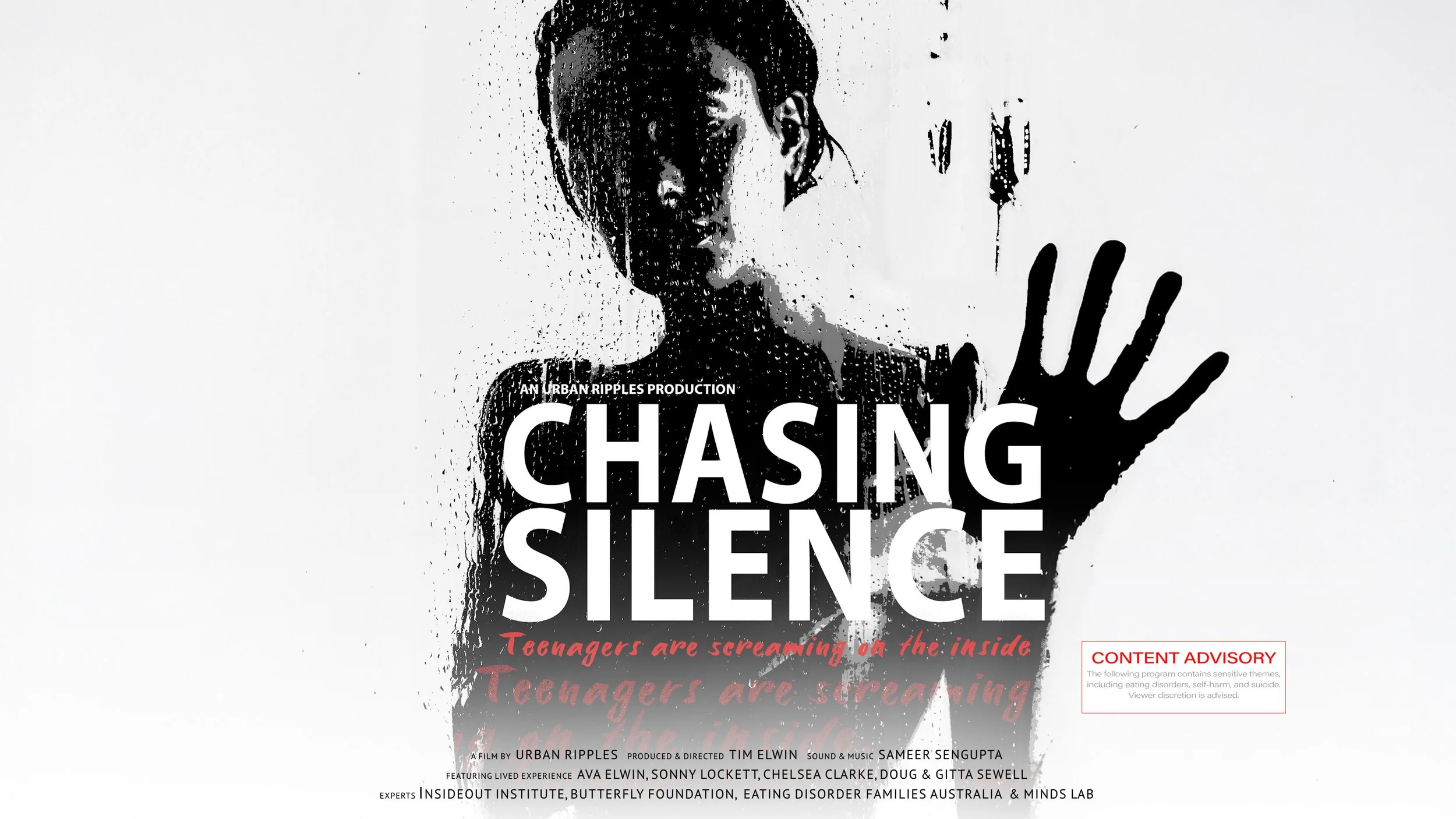
If your child
was suffering,
would you know?
Chasing Silence follows a father's search for answers after almost losing his daughter to a 6-year storm of eating disorders and self-harm. Across Australia, teenagers are turning to pain and silence to survive their inner turmoil.
This raw, unfiltered documentary sits with the brutal paradox that eating disorders are only the symptom, pain is the relief, and that's what they become addicted to.
Help us finish
this film.
Asking parents to pay to access life-saving information for their kids feels wrong, is wrong.
4.4 million Australian parents, carers, and family members are living with the impact of an eating disorder right now. Most have no idea what they are looking at until it is too late. Those families are already stretched financially and emotionally. So we are committed to keeping this film free for as many parents as possible, for as long as possible.
But films like this cost real money to make and real money to keep free. We are a small independent production house shining light on a life-threatening topic most people do not want to talk about. We need a community behind us that believes these kids deserve a fighting chance, and that every parent deserves to see this film FOR FREE before it is too late.
100% of donations goes towards making the film.
$50 helps us film another minute of this story. $10 puts it in front of a family who needs it. Every dollar helps a family before it's too late.


Get early access
for free.
Sign up to be first to know when Chasing Silence is ready to watch. Australian subscribers GET FREE ACCESS to the film with early notification of production updates, screening dates, nothing else.
A film built on
lived experience
and clinical expertise
Chasing Silence is built on the lived experience of families who have been through it, and grounded by the expert knowledge of the clinicians and researchers who understand it best. Because the only way to make a film like this right is to make it with the right people.
Eating Disorders Families Australia is the only national organisation providing support, education, advocacy, and counselling SOLELY for carers and families impacted by an eating disorder.
Within the film, EDFA bridge the gap between the teenager's pain and the family's need for practical tools. This ensures the story is led by lived experience as well as connecting parents directly to peer-led support and specialist advocacy.
InsideOut is Australia's national institute for research, translation, and clinical excellence in eating disorders. With resources, rigour and perseverance, it aims to transform the landscape for people with eating disorders in this country and ultimately find a cure. The Institute comprises a team of expert researchers, clinicians, and public policymakers committed to ensuring every person with an eating disorder has access to the best possible care.
As a key expert voice in Chasing Silence, InsideOut Institute translates complex science into clear, understandable information providing families with a practical roadmap for medical support and early intervention.
Butterfly Foundation is Australia's national charity for eating disorders and body image issues, supporting individuals, families, and carers across every stage of the journey. They provide evidence-based support services, education, and advocacy to reduce the harm caused by eating disorders nationwide.
Within Chasing Silence, Butterfly Foundation brings frontline clinical insight into the behaviours driving eating disorders and self-harm, ensuring the film reflects the real patterns families encounter and connecting viewers directly to national support services.
SDECC is a Not-for-Profit organisation which specialises in providing free counselling and support for young people aged 12-25 with alcohol and other drugs (AOD) and other co-occurring mental health challenges, and their families across Sydney.
We have partnered with SDECC to provide the clinical framework for our lived experience protocols, trauma-informed oversight, and specialist mental health support for both subjects in Chasing Silence and the crew filming it. This ensures a safe and ethical environment for all involved.

Dr Natalie Matosin is a neuroscientist and Head of the MINDS Lab at the University of Sydney, where her research examines how stress physically reshapes the human brain at a molecular and cellular level. Her work has shown that stress experienced early in life leaves lasting changes in brain tissue that can raise the risk of psychiatric disorders later on.
In Chasing Silence, Dr Matosin helps parents understand the biology behind what they are witnessing. She explains how chronic stress alters the brain's structure and function, and why the behaviours teenagers turn to for relief can become deeply ingrained responses, not choices, but patterns set in motion by a brain under constant pressure.
Not just presenting the story, but living it. Tim's perspective shines essential light as a parent with a teenager living with eating disorders, self-harm, suicide attempts, and OCD, as he tries to keep his daughter alive.
Living with eating disorders, self-harm, suicide attempts, and OCD. Now 19. Still struggling. Still here. Ava shares her story on her own terms. Not knowing if she's transformed through the hardest struggles to stay alive.
Bullied over his sister's trauma, Sonny retreated into a world of anxiety and suicidal silence. He shows us how rituals that start as safety can turn into a prison and how isolation becomes the most dangerous symptom of all.
Parents rebuilding life after losing their daughter to an eating disorder. Their story reveals the lasting impact on families who missed the warning signs, and the courage it takes to keep speaking when silence feels safer.
Teenager navigating the tightrope between control, fear, and understanding. Her story reflects the push and pull of love and frustration every parent faces when their child's pain becomes too hard to reach.
If you or someone you know needs support
- Lifeline 13 11 14 - 24/7 crisis support
- Kids Helpline 1800 55 1800 - for young people aged 5-25
- Butterfly National Helpline 1800 33 4673 - eating disorders and body image
- 13YARN 13 92 76 - crisis support for Aboriginal and Torres Strait Islander people
- In an emergency call 000.
Lived Experience Eating Disorder Documentary
-
Source list for the headline statistics used in pitch and treatment documents. Compiled for fact discipline and reuse across drafts. Sources checked against primary or peer-reviewed material to May 2026.
Project
Chasing Silence (feature documentary)
Producer
Tim Elwin, Urban Ripples Pty Ltd
Document
Documentary statistics source list
Updated
19 May 2026
Statistics with sources
1. Anorexia nervosa has one of the highest mortality rates of any mental illness in Australia.
Source: Touyz S et al. (2023), What kind of illness is anorexia nervosa? Revisited, Journal of Eating Disorders. ncbi.nlm.nih.gov/pmc/articles/PMC10714619
Supporting: Butterfly Foundation and Deloitte Access Economics (2024), Paying the Price 2024; National Eating Disorder Collaboration (NEDC); Eating Disorders Victoria.
Note: Most peer-reviewed sources say anorexia nervosa has the highest mortality rate of any psychiatric disorder. The softer wording ("one of the highest") is safer because a few researchers argue the comparison across psychiatric conditions is methodologically complex. See The Conversation FactCheck (2016), theconversation.com/factcheck-qanda...66495.
2. 1.1 million Australians are currently living with an eating disorder.
Source: Butterfly Foundation and Deloitte Access Economics (2024), Paying the Price 2024: The economic and social impact of eating disorders in Australia. butterfly.org.au/payingtheprice2024
Detail: 1.1 million Australians, or 4.5% of the population, are currently living with an eating disorder. 10.5% experience an eating disorder at some point in their lifetime. Prevalence is up 21% since 2012.
3. 4.4 million Australians are directly affected, including parents, carers and family members.
Source: Eating Disorders Families Australia (EDFA), March 2024 media release. edfa.org.au
Note: The 4.4 million figure is an EDFA estimate, derived from the 1.1 million Paying the Price 2024 prevalence figure on the basis of an assumed average of three family members affected for each person living with the illness. Widely used across the sector but is an estimate, not a directly measured population.
Watch out: Butterfly Foundation also uses a separate, coincidental "4.4 million Australians, one in six of us, self-identify as having symptoms of an eating disorder" (Dr Jim Hungerford, Feb 2025). Do not conflate the two. The carer or family figure and the self-identified symptom figure measure different things.
4. 1 in 3 Australian teenagers show signs of disordered eating.Source: Sparti C, Santomauro D, Cruwys T, Burgess P, Harris M (2019), "Disordered eating among Australian adolescents: Prevalence, functioning, and help received", International Journal of Eating Disorders, 52(3): 246-254. pubmed.ncbi.nlm.nih.gov/30734332
Cited via: National Eating Disorder Collaboration (NEDC), "Eating Disorders in Australia". nedc.com.au
Detail: 31.6% of Australian adolescents engaged in disordered eating behaviours within a 12-month period. Comprises 25.7% subclinical, 11.0% suspected eating disorder, and 0.9% with a lifetime diagnosis.
5. Teen boys now account for 1 in 4 new eating disorder cases.
Source (current): Morris R et al. (2022), "Early-onset eating disorders in Australian children: A national surveillance study showing increased incidence", International Journal of Eating Disorders. onlinelibrary.wiley.com/doi/full/10.1002/eat.23794
Detail (current): 25% (1 in 4) of confirmed early-onset eating disorder cases in Australian children aged 5-13 were boys, drawn from a national paediatric surveillance study (Feb 2016 - March 2018).
Source (historical baseline): Hay P et al. (2008), cited via Eating Disorders Victoria. eatingdisorders.org.au statistics
Detail (historical): Historically around 80-85% of anorexia and bulimia diagnoses in Australia were female, meaning male share sat at roughly 1 in 6 (15-20%).
Supporting (Australian rise in male prevalence): Mitchison D, Mond J, Slewa-Younan S, Hay P (2013), "The prevalence and impact of eating disorder behaviours in Australian men", Journal of Eating Disorders, 1(Suppl 1): O23. ncbi.nlm.nih.gov/pmc/articles/PMC3980982 - men represented 23-41% of Australian participants reporting eating disorder features in 1998 and 2008 community surveys; extreme dieting and purging increased at a faster rate in men than women over that decade.
6. 1 in 10 Australian teenagers have self-harmed.
Source: Australian Institute of Health and Welfare (AIHW), Australia's youth: Mental illness, drawing on the Young Minds Matter survey (Second Australian Child and Adolescent Survey of Mental Health and Wellbeing, 2013-14). aihw.gov.au/reports/children-youth/mental-illness
Detail: Among Australians aged 12-17, around 1 in 10 (11%, or about 186,000) reported they had deliberately injured themselves. Rates are roughly twice as high among females as males (15% compared with 6.8%). Females aged 16-17 had the highest rates, with 17% having self-harmed in the previous 12 months.
7. 50% of mental health challenges begin before age 14.
Primary source (Australian): National Mental Health Commission (2021), National Children's Mental Health and Wellbeing Strategy. mentalhealthcommission.gov.au
Australian Government wording (direct from the Strategy): "An estimated 50% of adult mental illness begins before 14 years of age." The figure is officially adopted into Australian Government mental health policy.
Underlying international source: Kessler RC, Angermeyer M, Anthony JC, et al. (2007), "Lifetime prevalence and age-of-onset distributions of mental disorders in the World Health Organization's World Mental Health Survey Initiative", World Psychiatry, 6(3): 168-176. ncbi.nlm.nih.gov/pmc/articles/PMC2174588
Detail: Half of all lifetime mental health disorders have an onset by age 14, and three-quarters by age 24. The figure derives from WHO World Mental Health Surveys data (Kessler 2007). It is widely cited across Australian policy and youth mental health material, including by the National Mental Health Commission, AIHW, Black Dog Institute, and headspace. For external use, cite the NMHC strategy first.8. Girls aged 15-19 have the highest rate of self-harm hospitalisation of any age group in Australia.
Source: Australian Institute of Health and Welfare (AIHW), National Suicide and Self-Harm Monitoring System, Self-harm hospitalisations (2023-24 data released 2025). aihw.gov.au/suicide-self-harm-monitoring
Detail (2023-24): More than 24,000 Australians were hospitalised for intentional self-harm. Females accounted for 64% (15,409 hospitalisations). Rates per 100,000 population - females aged 15-19: 405; females aged 20-24: 253; males aged 15-19: 114; males aged 20-24: 114.
Trend note: Rates of self-harm hospitalisation among young females rose until 2020-21 and have declined steadily since across most jurisdictions, except the ACT. Rates remain well above pre-pandemic levels. The honest framing is "rose sharply during the pandemic and remain elevated", not "still rising".
Why this matters alongside stat 6: Stat 6 (1 in 10 have self-harmed) is self-reported survey data from 2013-14. Stat 8 is hospital admissions, updated annually. Different measures, complementary stories. Stat 8 is the freshest, most dateable national figure available.
9. 34% of young people aged 14-19 reported suicidal thoughts or behaviours in the last 12 months.
Source: Australian Institute of Family Studies (AIFS), Suicidal thoughts and behaviours in adolescence (May 2026), drawing on the Longitudinal Study of Australian Children (LSAC). aifs.gov.au research snapshot
Detail: 34% of young people aged 14-19 reported suicidal thoughts or behaviours. Females (38%) more likely than males (31%). Ideation, planning and attempts each peaked at age 16-17 for females; for males the peak was also at 16-17 but planning continued rising into 18-19. Within the cohort: 3% had persistent suicidal thoughts and behaviours, 10% showed emerging patterns, and 7% showed improving trajectories.
Context: ABS 2020-22 National Study of Mental Health and Wellbeing found 3.3% of people aged 16-85 reported suicidal thoughts and behaviours in the last 12 months; 4.9% among those aged 16-34. The LSAC figure for 14-19 year olds is much higher because it covers a developmental peak period and uses different sampling.
10. Mental disorders in young Australians aged 16-24 rose 50% in 14 years (2007 to 2021).Source: McGorry P, Mei C, Hartmann J et al. (2023), "Mental health of young Australians: dealing with a public health crisis", Medical Journal of Australia, 219(6), drawing on the ABS National Study of Mental Health and Wellbeing (2020-22). mja.com.au
Detail: The prevalence of operationally defined mental disorders in 16-24 year-olds rose by 50% - from 26% in 2007 to 39% in 2021. The rise in young women was more marked, with rates reaching 48%. Pure Australian data, recent, replicable.
How this sits alongside stat 7: Stat 7 is the age-of-onset figure - when mental illness begins (half by age 14). Stat 10 is the trend figure - how much prevalence has grown in 14 years. Different stories, complementary. Stat 10 is the sharper headline if a single Australian stat is needed to make the case that the problem is worsening.
Consolidated reference list
Primary sources cited above, deduplicated.
1. Butterfly Foundation and Deloitte Access Economics (2024). Paying the Price 2024: The economic and social impact of eating disorders in Australia. butterfly.org.au/payingtheprice2024 - used for stats 1 (supporting) and 2.
2. Eating Disorders Families Australia (EDFA), March 2024. Carer demand media release citing the 4.4 million carer estimate. edfa.org.au media release - used for stat 3.
3. Sparti C, Santomauro D, Cruwys T, Burgess P, Harris M (2019). Disordered eating among Australian adolescents: Prevalence, functioning, and help received. International Journal of Eating Disorders, 52(3): 246-254. pubmed.ncbi.nlm.nih.gov/30734332 - used for stat 4.
4. National Eating Disorder Collaboration (NEDC). Eating Disorders in Australia (summary page citing Sparti et al. 2019). nedc.com.au - used for stat 4.
5. Hay P, Mond J, Buttner P, Darby A (2008). Eating disorder behaviors are increasing: findings from two sequential community surveys in South Australia. PLoS One. Cited via Eating Disorders Victoria, eatingdisorders.org.au statistics - used for stat 5 (historical Australian baseline).
6. Mitchison D, Mond J, Slewa-Younan S, Hay P (2013). The prevalence and impact of eating disorder behaviours in Australian men. Journal of Eating Disorders, 1(Suppl 1): O23. ncbi.nlm.nih.gov/pmc/articles/PMC3980982 - supporting source for stat 5 (Australian trend in male prevalence).
7. Morris R et al. (2022). Early-onset eating disorders in Australian children: A national surveillance study showing increased incidence. International Journal of Eating Disorders. Wiley - primary source for stat 5 (1 in 4 current).
8. Australian Institute of Health and Welfare (AIHW). Australia's youth: Mental illness, drawing on Young Minds Matter (2013-14). aihw.gov.au - used for stat 6.
9. Australian Institute of Health and Welfare (AIHW). National Suicide and Self-Harm Monitoring System: Self-harm hospitalisations (2023-24 data). aihw.gov.au/suicide-self-harm-monitoring - used for stat 8.
10. Australian Institute of Family Studies (AIFS) (May 2026). Suicidal thoughts and behaviours in adolescence. Drawing on the Longitudinal Study of Australian Children (LSAC). aifs.gov.au research snapshot - used for stat 9.
11. National Mental Health Commission (2021). National Children's Mental Health and Wellbeing Strategy. mentalhealthcommission.gov.au - primary Australian source for stat 7.
12. Kessler RC et al. (2007). Lifetime prevalence and age-of-onset distributions of mental disorders in the WHO World Mental Health Surveys. World Psychiatry, 6(3): 168-176. ncbi.nlm.nih.gov/pmc/articles/PMC2174588 - underlying international source for stat 7.
13. McGorry P, Mei C, Hartmann J et al. (2023). Mental health of young Australians: dealing with a public health crisis. Medical Journal of Australia, 219(6). mja.com.au - used for stat 10. Cites the ABS National Study of Mental Health and Wellbeing 2020-22.
14. Touyz S et al. (2023). What kind of illness is anorexia nervosa? Revisited. Journal of Eating Disorders. ncbi.nlm.nih.gov - used for stat 1.
NOTE
• Young Minds Matter is dated (2013-14) - still the most recent nationally representative survey of its kind, but worth noting the vintage when presenting to funders or researchers.
• Replacement survey in fieldwork now - Young Minds: Our Future (third National Child and Adolescent Survey of Mental Health and Wellbeing). Led by Curtin University and University of Queensland, $8.1m Commonwealth funding. Fieldwork started November 2025, running 12 months. Results expected 2027. Stats 6 and 7 will be replaceable with fresh national figures then. health.gov.au study page
• AIHW hospitalisation data is updated annually - stat 8 should be refreshed each time AIHW releases a new National Suicide and Self-Harm Monitoring update (typically annual)
Chasing Silence: frequently asked questions
-
Chasing Silence is an Australian feature documentary about eating disorders, self-harm and teen mental health, told from a parent's point of view. It helps parents and carers recognise the early warning signs and act before silence turns to tragedy. It is built on real lived-experience stories and backed by clinical evidence.
-
It is directed by Tim Elwin and produced by Urban Ripples, the team behind The Definition of Happiness. The film has received development funding from Screen Australia.
-
The film is in production and scheduled for release in late 2026. Register at urbanripples.com/chasing-silence to be invited to watch when it launches.
-
Chasing Silence is built to be free. It releases in late 2026. Sign up for a free launch invitation.
-
The film is backed by Screen Australia development funding and supported by the Butterfly Foundation, EDFA and the InsideOut Institute, with clinical oversight informing the production.
-
You can donate through the Australian Cultural Fund. All donations over $2 are fully tax deductible. You can also help by sharing the film with parents and carers.
100% of donations goes towards making the film.If you or someone you know is struggling: Butterfly Foundation 1800 33 4673, or Lifeline 13 11 14.
“I don’t want to make this film, I have to. For 6 years, I’ve watched someone I love get lost in the storm: eating disorders, self-harm and multiple attempts at silence. I’ve seen the hiding. The hunger. The harm. The addictions. The moments of relief that only come through pain. Because self-harm and eating disorders aren’t the problem, they’re just the symptom.”
“I thought it was just adolescence. Mood swings, pulling away, becoming a fussy eater. By the time I understood what was going on, the eating disorder already had a full hold of her.”
“Chasing Silence tells the stories that need to be told. Fear and pain engulf those with an eating disorder. Stress, helplessness and isolation ripple through the entire family. At Eating Disorders Families Australia we know that greater understanding leads to greater compassion, support and hope, and that’s why I leapt at the chance to be part of this film.”